
FieldDataSync


DLG AgriFuture Concept Winner 2025
We are proud to share that the project FieldDataSync has been awarded the AgriFuture Concept Award 2025 from the German Agricultural Society (DLG)!
Meet us at Agritechnica, TUM booth 24E14, and learn more about our vision for the future of agriculture.
Topic: Development of a manufacturer-independent wireless communication solution for agricultural machinery without internet connections. Implementation of secure collaboration among multiple machines in a field area with real-time process data exchange.
Keywords: Manufacturer-independent wireless communication, Real-time data exchange, Interoperability in agricultural machinery, Vehicle group management, ISO 11783 standard extensions
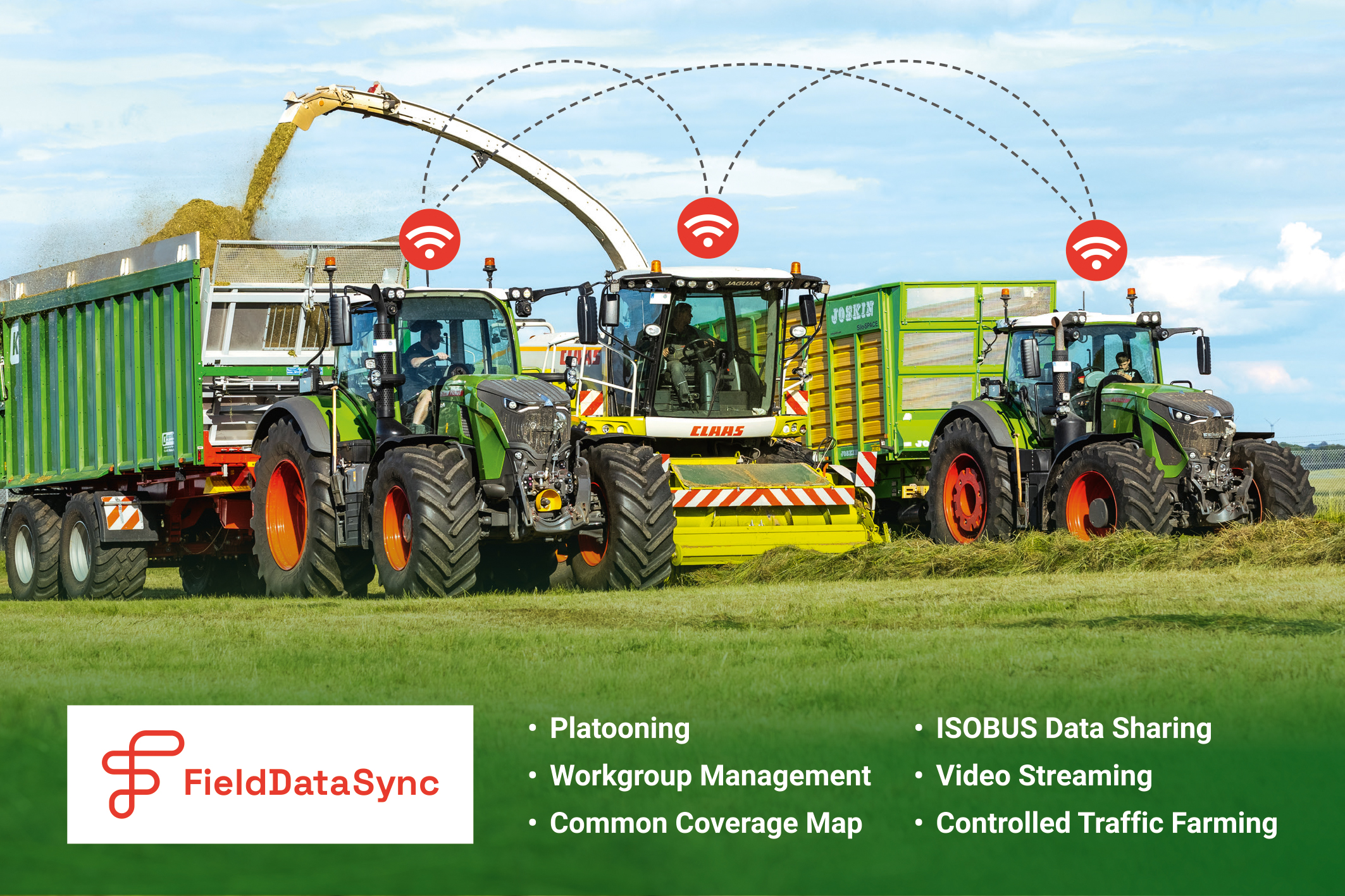
In the FieldDataSync project, a manufacturer-independent, wireless data transmission solution is being developed, enabling communication between agricultural machines without relying on mobile internet connections. This allows multiple working devices to collaborate on a single field, even in remote regions, and share data securely and reliably in real-time. The special focus on the solution's interoperability builds on the existing ISO 11783 standard as well as the prior work of the AEF.
Besides the pure wireless technology, the FieldDataSync project also focuses on vehicle group management. This aims to enable multiple (autonomous) machines to collaborate seamlessly over long distances, for example, by sharing joint coverage maps of the already worked area in real time. As an example, this enables to work with multiple vehicles simultaneously in the same field without incurring losses due to double processing. Other use cases target joint navigation or controlled traffic farming with multiple vehicles. Additionally, remote control of individual actuators, video stream transmission, and the display of process data are enabled by wireless communication and are examined both theoretically and practically in the project.
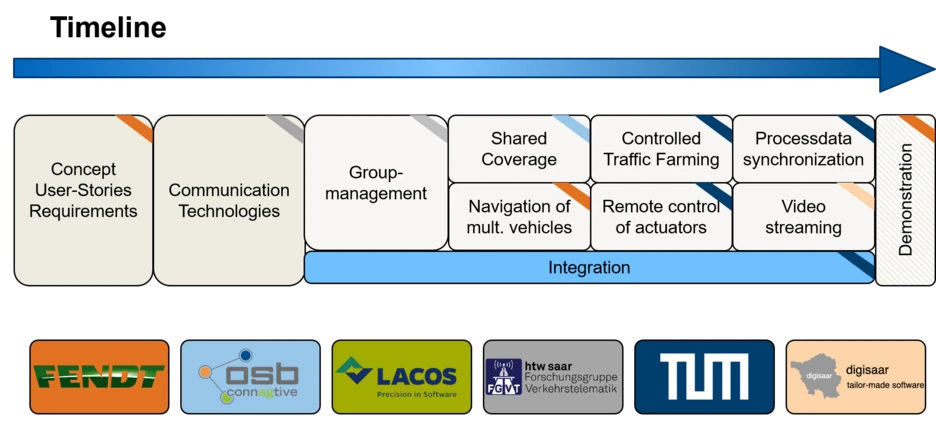
The FieldDataSync project involves comprehensive planning and development of a manufacturer-independent, wireless data transmission solution for agriculture. In the first work package, based on the requirements of farmers as well as tractor and implement manufacturers, the concept development up to the integration of the developed technologies into agricultural vehicles will be elaborated. Building on this, the selection of wireless communication technologies and the implementation of algorithms for the robust formation and management of machine groups will take place. A special focus is on the interoperability of the solution to ensure communication between machines from different manufacturers.
Solutions for the application-specific sharing of coverage maps, the navigation of multiple vehicles in the field, the remote control of actuators, and video streaming between machines will be developed. The applicability of the developments will be tested through ongoing demonstrations with real machines and work processes and presented to a broad audience, for example, at trade fairs. The goal is to enable secure and efficient wireless communication to increase productivity and efficiency in agriculture.
Results
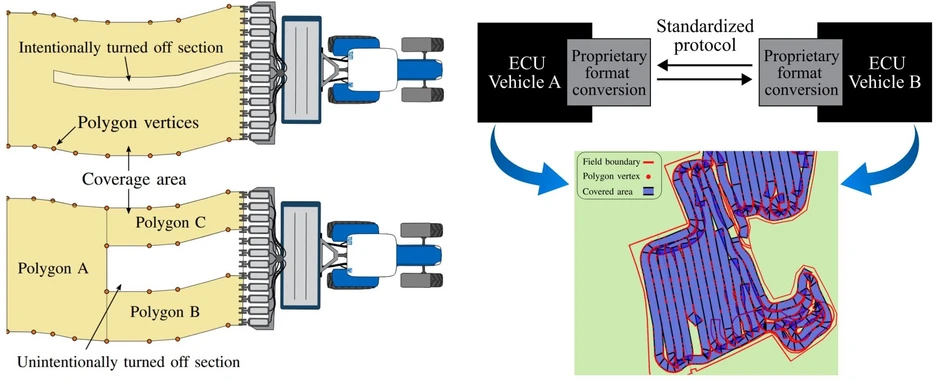
Optimized Coverage Map Exchange for Connected Agricultural Machines
Coverage maps are a fundamental tool for documenting field operations and enabling coordinated machine activities. However, despite their widespread use, the ISO 11783 standard does not currently provide a standardized definition or exchange format for coverage maps.
Within the FieldDataSync project, we address this challenge by developing methods for efficient, real-time sharing of coverage maps between multi-brand agricultural machines, Task Controllers, and cloud-based systems. A key objective is to ensure reliable data exchange even under bandwidth constraints and in environments with multiple communicating systems.
Our research introduces a compact and efficient representation of coverage maps that significantly reduces communication overhead while preserving the information required for operational decision-making.
Key results
- Compact polygon-based structure for coverage map representation
- Location-independent coordinate scaling with configurable spatial resolution
- Reduced data volume through vertex minimization and relative coordinate encoding
- Optimized reference-point selection for enhanced transmission efficiency
- Up to 4.66× smaller message sizes at 2 cm resolution on real-world datasets, without applying payload compression algorithms
These results contribute to more robust and scalable real-time collaboration between agricultural machines, task management systems, and cloud services, supporting the next generation of precision agriculture applications.
Read the paper:
Optimized Coverage Map Representation for Bandwidth-Limited Data Exchange of Agricultural Vehicles
Marcel Moll, Samuel Brodie, and Timo Oksanen
https://doi.org/10.1109/TAFE.2026.3669618
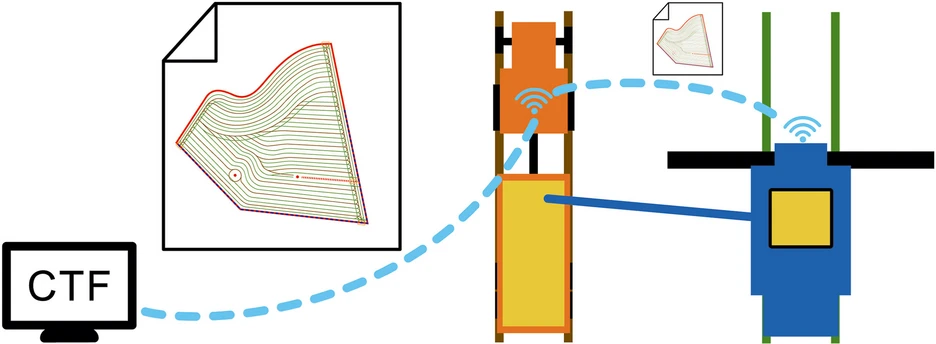
Standardizing Controlled Traffic Farming Representation for Multi-Brand Machine Fleets
Controlled Traffic Farming (CTF) is an agricultural management approach that minimizes soil compaction by ensuring that field operations are performed along predefined traffic lanes. By restricting machine movement to dedicated paths, CTF can improve soil structure, increase water infiltration, reduce erosion, and support higher crop productivity.
Within the FieldDataSync project, we are exploring how wireless interoperability can enable multiple machines from different manufacturers to operate simultaneously within a shared CTF system. Achieving this vision requires a standardized way to describe and exchange traffic lanes, including complex curved paths, across machines, guidance systems, and farm management platforms.
A key challenge is that existing agricultural data standards were not designed to fully support the information required for automated and interoperable CTF workflows. Our research therefore investigates the requirements for a future data exchange framework that can enable coordinated multi-brand operations while preserving interoperability throughout the agricultural ecosystem.
Key results
- Systematic analysis of data requirements for automated Controlled Traffic Farming systems
- Identification of information that must be represented to support coordinated machine guidance on shared traffic lanes
- Evaluation of existing agricultural data standards, including ISO-XML and ADAPT
- Assessment of current limitations in representing CTF-specific information and workflows
- Identification of gaps that must be addressed to achieve seamless interoperability between mixed fleets
- Foundation for future standardization efforts supporting automated multi-machine CTF operations
The results demonstrate that while existing standards provide valuable building blocks, neither ISO-XML nor ADAPT can currently represent all information required for advanced Controlled Traffic Farming applications. This work establishes a basis for future developments toward standardized, interoperable CTF data exchange, enabling the benefits of controlled traffic systems to be realized across multi-brand machine fleets.
Read the paper:
Data Exchange Requirements for Automated Controlled Traffic Farming Systems
Henri Hornburg, Timo Oksanen
https://doi.org/10.1016/j.biosystemseng.2025.104321

Safe Wireless Remote Control of Binary Actuators in Agriculture
As agricultural operations become increasingly connected, wireless machine-to-machine (M2M) communication enables closer cooperation between machines from different manufacturers. One important application is the remote control of binary actuators, such as starting or stopping a combine harvester’s unloading auger, operating sprayer valves, or initiating an emergency stop on another machine.
Within the FieldDataSync project, we are investigating how these safety-critical functions can be controlled reliably across wireless connections. Building upon the Tractor Implement Management (TIM) framework of the ISO 11783 standard, our work aims to establish a dedicated interface that enables the secure discovery and remote operation of machine functions while minimizing the risk of misuse and communication-related failures.
A particular focus is on safety-critical use cases, where incorrect, delayed, or misunderstood commands could create hazardous situations. To address these challenges, we combine established approaches from functional safety and Safety of the Intended Functionality (SOTIF) to systematically identify risks and develop mitigation strategies.
Key results
- Comprehensive hazard analysis for wireless remote control of binary actuators in agricultural machinery
- Identification of safety risks, including communication loss, corrupted or delayed commands, consent mismatches, and operator awareness issues
- Integration of functional safety (ISO 25119) and SOTIF (ISO 21448) perspectives to address both system faults and fault-free unsafe behavior
- Definition of mitigation measures across communication, control logic, and human-machine interface layers
- Concepts such as consent-based control, fail-safe timeout behavior, message integrity verification, command ordering, and clear operator feedback
- Foundation for future standardized interfaces enabling safe multi-brand machine cooperation
By addressing both technical reliability and human interaction aspects, this work contributes to the safe deployment of wireless M2M communication for collaborative agricultural operations. In particular, the ability to remotely initiate emergency stop functions across machines has the potential to significantly improve safety during field work.
Read the paper:
Safety Analysis on Wireless M2M Communication for the Remote Control of Binary Actuators in Agriculture
Changjoo Lee, Andreas Neubauer, Henri Hornburg, and Timo Oksanen.
Acknowledgments
This project is funded by the Federal Ministry of Agriculture, Food and Regional Identity (BMELH).