
SDC – Smart Drilling Cell
In the aerospace industry, rivets are often used to assemble aircraft components. This requires holes to be drilled through multilayer material packages. Large aircraft structures require thousands of holes to be drilled and there is a need to increase the speed of the drilling process while reducing drilling errors such as drill breakage, drill inaccuracy, or burr formation as errors can lead to costly quality checks and post-processing.
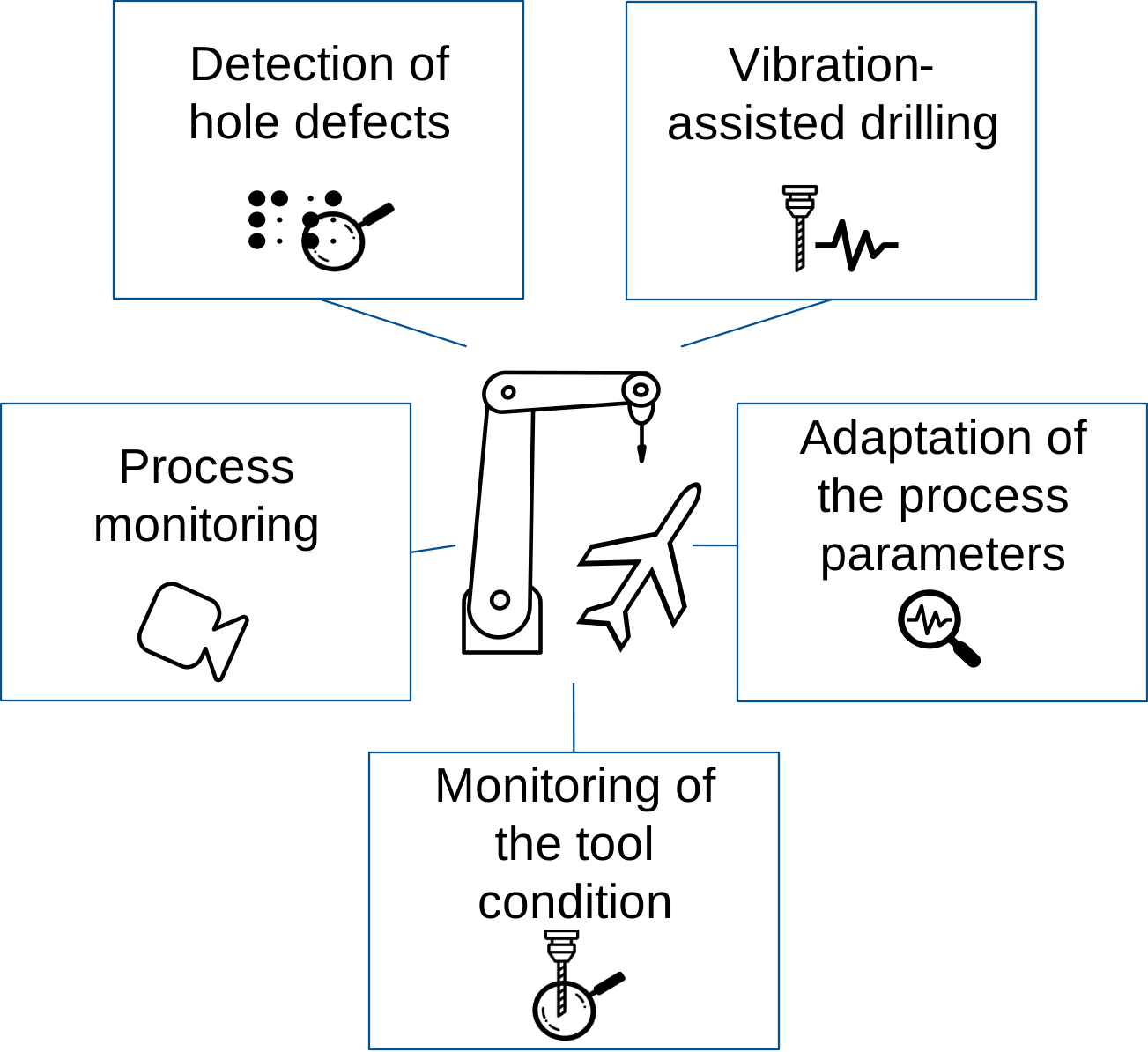
As part of the Smart Drilling Cell (SDC) project with Boeing Research and Technology – Europe, methods are being investigated to detect and prevent drilling errors and to monitor tool wear. Sensor data will be used to identify defect patterns and predict their occurrence while suitable process parameters will be determined to avoid defect patterns. In addition, the dynamic adaptation of these parameters during the drilling process will be investigated.
Motivation
Drilling defects occur particularly when drilling multilayer material packages, such as carbon fiber-reinforced plastics and metallic materials (e.g., aluminum alloys). Such material packages are often used in the aerospace industry with high safety requirements. As a result, process errors lead to quality problems, and costly post-processing steps become necessary. Adaptive process parameters and vibration-assisted drilling, amongst others, can reduce and prevent such defects. This motivates the research on the industrial applicability of these approaches.
Objective
The objective of the project is to improve the drilling processes and the quality of the holes for multi-layer material packages. This reduces post-processing and associated production costs.
For this purpose, we will expand the knowledge of vibration-assisted drilling, especially focusing on its industrial applicability. A further aim of the project is to develop methods to monitor the tool condition and early detection of hole defects. A feasibility study regarding the prediction of the occurrence of these hole defects and the adaptation of the process parameters will be presented and used to enhance the quality of the holes. In this way, costly post-processing can be avoided, and the drilling quality can be sustainably ensured. In addition, the long-term cooperation with industrial partner Boeing Research and Technology – Europe ensures knowledge transfer between research and industry.
Approach
In close cooperation with Boeing Research and Technology – Europe, a test setup for evaluating and improving vibration-assisted drilling of structural aircraft components will be established at the iwb.
Characteristic defect patterns will be identified, and process data, such as the occurring torque, will be monitored. Based on these sensor signals, anomaly detection and monitoring of the tool condition will be used to draw conclusions about the occurrence of the identified defect patterns.
Once the methods have been successfully tested, they will be transferred to drilling processes using other tools or material packages. In addition, the data-based prediction of defect patterns will be investigated, and the implementation will be tested under industry-oriented conditions within the test setup. Finally, the adaptation of process parameters such as feed rate and spindle speed will be investigated to reduce the occurrence of defect patterns.
Impact and Applications
Working with an industry-oriented system ensures the transferability of the scientific findings with regards to quality assurance, thereby contributing to further development of industrial drilling processes on aircraft structural components.
By using process monitoring and adaptive process control, early detection of drilling defects can be ensured, and the drill hole quality in airplane manufacturing improved. This reduces the effort for post-processing, lowers production costs, and improves the overall process reliability.
Acknowledgements
This research project is conducted in cooperation with Boeing Research and Technology – Europe. We thank our industrial partner for this impactful collaboration.