
Experimentally Verified Determination of the Influence of Grain Size on the Flank Fracture Load Carrying Capacity of Case-Hardened Cylindrical Gears
Research Topic
| Short Title | Grain Size Impact Tooth Flank Fracture |
| Start of Project | Q3/2025 |
| Funding | FVA-Nr. 1075/I Research Association for Drive Technology e.V., FVA |
| Contact | Dr.-Ing. T. Tobie |
Project Description
The aim of this research project is to derive statistically reliable parameters for the influence of grain size on the tooth flank fracture load-carrying capacity. To accomplish this, endurance tests are used to determine the fatigue strength of different grain size variants in the Woehler fatigue test. By comparing a fine-grain reference and a coarse-grain variant, the strength-reducing influence of the coarse-grain structure is to be characterized.
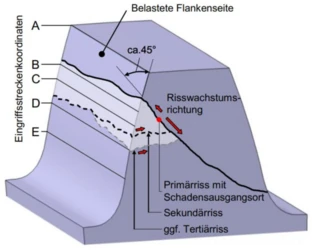
Advances in increasing the load-carrying capacity of gears regarding damage originating from cracks near the surface (tooth root fracture and pitting) often shift the origin of the damage deeper into the material [Wit12a]. Tooth flank fracture is a fatigue damage with crack initiation below the active tooth flank, often in the transition area from the hardened surface layer to the core [Wit12b].
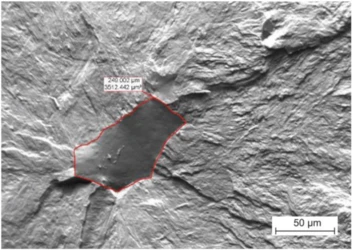
To date, there is no data on the quantitative impact of increased coarse grain content on the flank fracture load-carrying capacity of gears available in literature. Initial findings in the research project FVA 848 I [Cas23], have demonstrated the influence of coarse grain content on tooth flank fracture load capacity via preliminary tests. However, further investigations are needed to enable statistically robust conclusions regarding the impact of coarse grain structure on the tooth flank fracture load-carrying capacity of case-hardened gears.
This necessity forms the basis of the present research project, which aims to conduct a statistically validated analysis of the influence of coarse grain microstructures on the tooth flank fracture failure mode. The objective is to derive quantitative insight into the strength degradation associated with coarse grain structures, relative to the fine grain microstructures typically employed in industrial practice.
Based on the experimental results obtained in the research project, standardized parameters are to be derived for incorporating the influence of grain size into the design of gears with respect to tooth flank fracture in ISO/TS 6336-4 [ISO19]. Furthermore, recommendations will be developed for ISO 6336-5 [ISO16] regarding permissible material properties relevant to tooth flank fracture. These outcomes aim to enhance the reliability and accuracy of gear design by integrating microstructural considerations into existing normative frameworks.
Literature
[Cas23] Castens, M.; Fuchs, D.; Rommel, S.; Steinbacher, M.; Tobie, T.; Fechte-Heinen, R.; Stahl, K.: FVA 848 I, IGF-Nr. 19986 N - Grobkorn Abschlussbericht - Einflüsse auf die Ausbildung und Wirkung von Grobkorn in Al-N stabilisierten Einsatzstählen, Forschungsvereinigung Antriebstechnik, Frankfurt/Main, Heft 1559 (2023).
[ISO16] ISO 6336-5:2016-8: Calculation of load capacity of spur and helical gears - Part 5: Strength and quality of materials (2016).
[ISO19] ISO/TS 6336-4:2019-1: Calculation of load capacity of spur and helical gears - Part 4: Calculation of tooth flank fracture load capacity (2019).
[Wit12a] Witzig, J.: Flankenbruch - Eine Grenze der Zahnradtragfähigkeit in der Werkstofftiefe, Dissertation, Technische Universität München (2012).
[Wit12b] Witzig, J.; Tobie, T.; Stahl, K.: FVA 556 I: Flankentragfähigkeit-Werkstofftiefe - Entwicklung eines erweiterten Berechnungsverfahrens zur Ermittlung optimaler Zahnflankentragfähigkeit bis in den Bereich großer Werkstofftiefen, Forschungsvereinigung Antriebstechnik, Heft 1000 (2012).