
Synchronizers
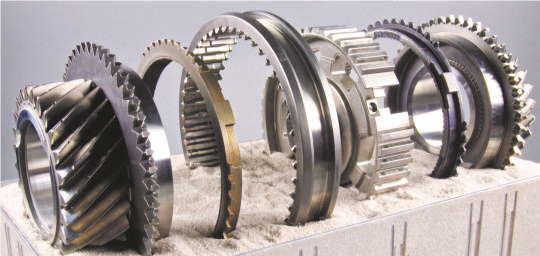
Operating gear clutches perform gear changes in automotive manual transmissions. Synchronizers are used to equalize the speed in the tooth clutch, which is necessary for comfortable shifting. The requirements for synchronizers are application-specific and cover a broad spectrum. In addition to high torque transmission capacity and the associated tolerable high energy and power density for friction material and transmission oil, low wear, and good long-term consistency of the frictional behavior, good shifting comfort is an important research topic.
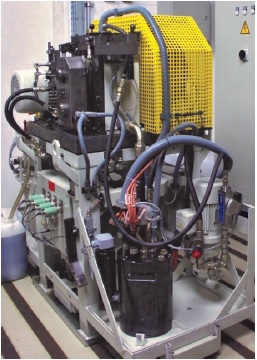
The standard synchronizer test rig at FZG is used to carry out investigations into the friction, wear, and service life behavior of synchronizers.
Complete series synchronizer packages of different designs are installed in the test rig. The influences of the lubricant, the stresses, and the material pairing on the service life are investigated as part of systematic service life tests.
Furthermore, knowledge of the friction behavior of the taper friction clutch of a synchronizer and its dependence on the influencing parameters is a fundamental prerequisite for optimizing the synchronizer. This is due to the tribological properties in the friction contact, which influence the design of the locking mechanism and the function, shifting comfort, service life, and drag torque behavior of the synchronizer. Six synchronization test rigs are available at the FZG.