
Climate Chamber
The climate chamber at the Chair of Ergonomics enables the precise reproduction of controlled and reproducible environmental conditions across a wide range of climatic parameters. The adjustable temperature range extends from -60 °C to -30 °C, while the relative humidity can be regulated from 10% to 90% RH. This allows for the realistic and stable simulation of both extreme winter and summer conditions, as well as varying humidity levels.
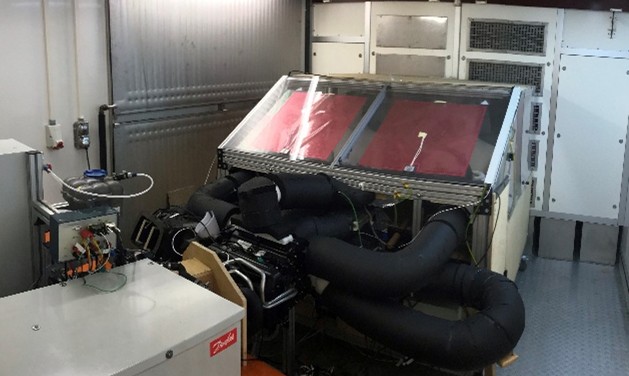

The facility is specifically designed for investigating thermophysiological processes and the thermal stress on humans under defined environmental conditions, as well as for analyzing thermal comfort and energy efficiency in vehicle interiors. The chamber incorporates a B-segment vehicle mockup with near-production interior geometry, equipped with a multi-zone HVAC system. HVAC parameters such as supply air temperature and air volume flow are controlled automatically via a Python-based control environment, enabling the realization of both steady-state and transient climate scenarios.
A key measurement technique used in the laboratory is a self-developed segmented climate dummy equipped with high-resolution temperature sensors. This enables the detailed recording of the local thermal stress on different body regions and simultaneously serves as a basis for coupling with thermophysiological models as well as with CFD-based digital twin simulations.
The laboratory's research focuses on the holistic analysis of thermal comfort and thermal stress on vehicle occupants under realistic, dynamic, and spatially non-homogeneous conditions. A particular emphasis is placed on the development and validation of energy-efficient climate control concepts for battery-electric vehicles. Furthermore, data-driven machine learning methods are employed to develop predictive models for the real-time forecasting of thermal perception and thermal comfort, and to integrate these models into intelligent control strategies for future vehicle generations.