Research topics
For the sake of transferability, a scientific approach should possess the highest possible degree of applicability. Therefore, research at the Chair of Ergonomics extends across a wide range of life areas. Here, the collaboration with the Chair of Sports Equipment and Materials is particularly important.
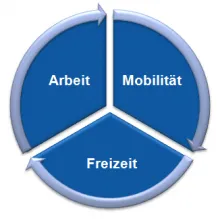
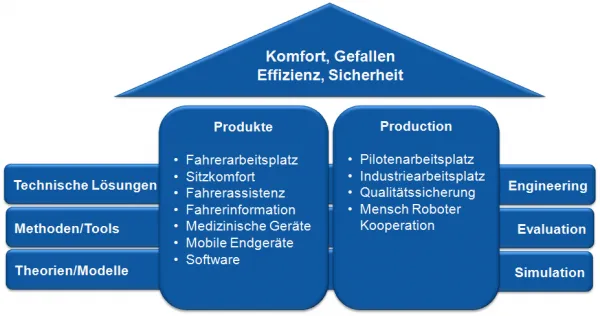
Research at the Chair of Ergonomics, in line with the concept of micro-ergonomics, focuses primarily on the design and evaluation of human interaction with technical systems. Particularly against the backdrop of current demographic and economic developments, the quality of ergonomic design and user-friendliness are becoming increasingly important for many products in global competition. This applies to both consumer goods and machinery in production environments. Innovative interaction technologies, such as touch controls or force-feedback actuators, enable the redesign of interaction concepts and, at the same time, require ergonomics to develop suitable evaluation methods, for example in the area of usability, to objectively measure their ergonomic quality. The Chair's expertise covers both anthropometric and cognitive aspects. Interdisciplinary research is conducted in very close collaboration with industry partners from diverse domains (aviation, automotive, workplace, sports) and with the involvement of end users (e.g. in the usability lab of the climate chamber or driving simulator) in order to develop new concepts and tools based on theories and models.
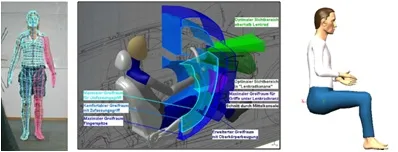
Digital human modeling for the ergonomic design of workplaces, products and vehicles
Especially in light of aging societies, manufacturers are focusing on designing the driver's workplace, and in particular the vehicle seat, to the highest ergonomic standards.
Therefore, ergonomic design, taking anthropometric requirements into account, will remain a key success factor alongside safety and efficiency. A central element here is optimizing the accessibility of input devices and the readability of displays for a wide range of drivers. Another aspect is reducing discomfort through optimized seating conditions.
At the Chair of Ergonomics, posture and pressure distribution were identified as empirical parameters for determining perceived discomfort—also with regard to assessing long-term effects. These evaluation dimensions have been partially integrated into the digital human model RAMSIS, enabling developers to consider anthropometric and comfort requirements in the early stages.
Since concept evaluation by test subjects is very time-consuming and costly, a valid digital human model is of paramount importance. Increasingly, cognitive properties are also expected to be considered alongside anthropometric aspects. Therefore, current research focuses on modeling visual and visuomotor processes.
Biomechanical modeling of forces and movements
The ergonomic evaluation of a product usually requires the construction of a physical mock-up or prototype, which is then tested by a group of experts or a representative sample of users. This is an expensive and time-consuming process. To counteract this, digital mock-ups combined with digital human models are increasingly being used in early stages of product development, leading to a reduction in development time and costs.
To assist designers in evaluating future products, digital human models should ideally behave like real people. This applies to the simulation of anthropometric characteristics, movements, discomfort, and work-related tissue injuries. The main goal of this research area is the development of advanced digital human models for ergonomic research and evaluation, taking demographic effects into account.
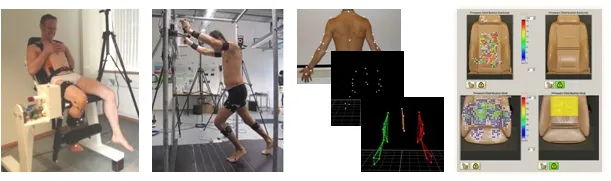
Another focus of the research area is the modeling of human (dis)comfort perception and the development of evaluation methods, especially in the area of human-seat interaction.
Investigation of interaction concepts for the efficient handling of future assistance systems and highly automated systems
The increasing number of sensors in vehicles enables more and more driver assistance systems, some of which can even take over the driving task. The growing variety of emerging interaction concepts can lead to mental overload for drivers. Therefore, it makes sense to develop a concept with an integrated interface.
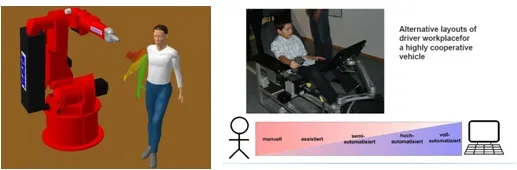
Due to improvements in sensor technology, driver assistance systems will be able to take over increasingly larger portions of the driving task in the future (see Adaptive Cruise Control and Lane Keeping Assist). This also applies to assistance and automation systems in aviation and process control. Future vehicles will be able to perform complex maneuvers and operate as autonomous vehicles in cooperation with the driver. A comparable development can be observed in human-robot collaboration and is already available in aviation.
In almost every area, the dilemma between safety and efficiency must be resolved. Users should be informed and motivated to act proactively in order to save energy and prevent dangerous situations. The question is how to enhance the user experience without overwhelming or patronizing users. In this context, interaction concepts for cooperative human-machine systems are being developed, enabling humans and machines to exchange their intentions as partners.
- "What is the next activity of the automated vehicle?"
- "What is the next activity of the cooperating robot?"
- "How predictable are human movements for a cooperative adaptive machine?"
- "To what extent is the cooperating partner (human or machine) still able to react appropriately, or limited by hypovigilance, situational awareness, fatigue, errors, malfunctions, and functional limitations?"
- "How will drivers/users learn to drive in the future when driving automated vehicles?"
- "How can it be ensured that human-robot interaction is not only technically implemented but also accepted by users; i.e., that users feel safe and are not inconvenienced by the presence of a robot?"
Development of assessment procedures
The use of displays in vehicles has increased steadily in recent years; voice control is a major promising technology for reducing driver distraction. The goal of all interaction concepts is to increase comfort and operational safety. However, it is not yet known whether new, additional functions might also contribute to overload and thus have a negative impact on driving safety. Therefore, it is necessary to equip developers with assessment methods for the early development phases.
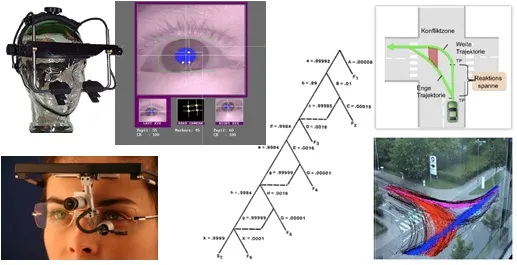
The institute is therefore investigating the potential of measuring pupil dilation and detecting peripheral stimuli for assessing cognitive workload under various interaction conditions. A key research objective is to develop and calibrate methods and indices for workload measurement, enabling continuous measurement even during periods of high levels of support and automation, and multimodal interaction.