
Cross-process modelling of a cold forging and machining process chain of an impeller wheel with consideration of specific uncertainties
Project 10 - DFG GEPRIS 558601144
Project description
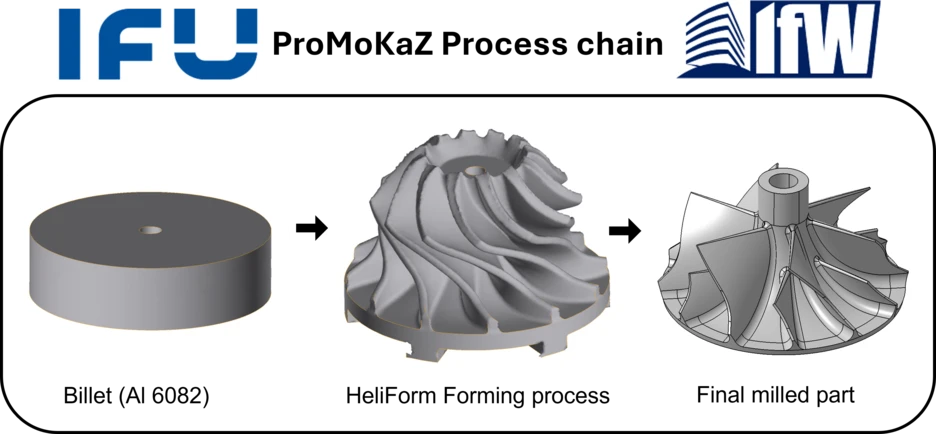
The research project ProMoKaZ (Cross-process modeling of a cold forming and machining process chain of a compressor wheel under consideration of specific uncertainties) aims to develop an integrated digital and experimental model of a complete production chain for a centrifugal compressor wheel. The chain combines cold forging of a near-net-shape preform and subsequent precision milling, with the goal of achieving tight geometric and surface tolerances while minimizing material, energy, and time consumption. Motivated by the need for sustainable and precise manufacturing, the project investigates how process and material uncertainties influence the final component quality. The central objective is a global, inverse multi-objective optimization of the process chain, balancing accuracy, surface finish, and resource efficiency. In the first funding phase, the team builds and validates detailed finite element (FEM) models of both forming and machining using DEFORM-3D, enriched with experimental data from thermomechanical and machining tests. Uncertainty quantification (UQ) methods, such as Bayesian inference, Monte Carlo simulation, and surrogate modeling (kriging, neural networks), are used to represent both epistemic and aleatory variability. A physical process chain is realized on industrial test rigs at the University of Stuttgart’s Institute for Forming Technology (IFU) and Institute for Machine Tools (IfW), integrating in-line sensors and soft sensors for real-time monitoring of forces, temperatures, vibrations, and microstructural evolution. By coupling the forming and machining models through shared data interfaces and surrogate models, the project will establish a cross-stage surrogate model capable of predicting and optimizing part quality under uncertainty. Ultimately, ProMoKaZ seeks to demonstrate how intelligent modeling and data-driven methods can make high-precision forming-machining chains more robust, efficient, and sustainable for future industrial applications.
Contact
Institute for Metal Forming Technology, Universit of Stuttgart
Project management: Univ.-Prof. Dr.-Ing. Dr. h. c. Mathias Liewald MBA
Project team: Radu Andrei Matei, radu-andrei.matei(at)ifu.uni-stuttgart.de
Institute for Machine Tools, University of Stuttgart
Project management: Univ.-Prof. Dr.-Ing. Dr. h. c. Hans-Christian Möhring
Project team: Cornelius Neun, cornelius.neun(at)ifw.uni-stuttgart.de