
Multi-criteria, comprehensive design of the manufacturing process of aluminum cold plates based on the holistic modeling of the process chain metal forming/laser welding
Project 7 - DFG GEPRIS 558591047
Project description
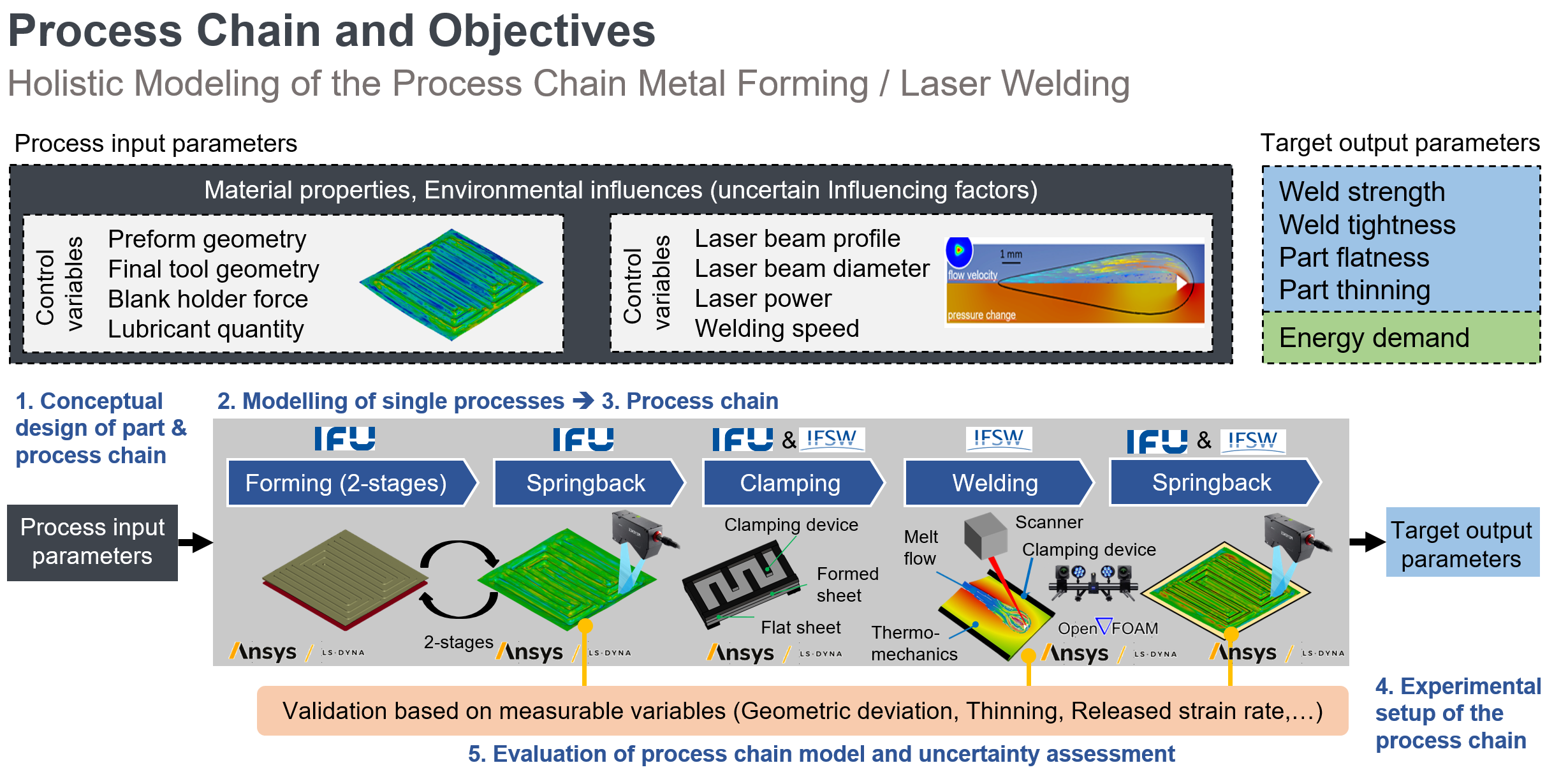
The project investigates the multi-criteria, cross-process design of the manufacturing chain for aluminum cooling plates used in battery systems. These components are critical for the efficiency, safety, and service life of electric vehicles and energy storage systems. They are made from formed sheets with integrated cooling channels, which are to be joined by laser welding.
The main challenges arise from conflicting objectives between forming and welding: forming is intended to reduce residual stresses in order to ensure dimensional accuracy of the cooling plate, whereas welding benefits from compressive residual stresses, since these counteract transverse cracking in high-strength 6000-series alloys. High feed rates, which are required for energy-efficient processing, further intensify transverse cracking due to pressure drops in the weld pool.
The goal of the project is the development of an integrated model of the forming/laser welding process chain that enables multi-criteria, quasi-inverse design. Deterministic input parameters such as tool geometry, friction conditions, laser power, and beam shaping will be considered, as well as uncertain parameters originating from material variability and environmental conditions. This will allow the identification of process parameters that ensure crack-free and dimensionally accurate components while minimizing energy consumption.
In the first funding period, the individual processes will be modeled and experimentally validated. This includes FE-based simulations of forming, coupled thermo-mechanical and fluid-dynamic models of welding, as well as meta-models and Bayesian optimization for robust parameter design. Complementary experiments will assess weld quality, leak tightness, and springback, thereby validating the models.
The project thus establishes the foundation for a holistic optimization of the process chain. In the long term, it will enable the reliable manufacturing of cooling plates made from high-strength aluminum alloys, thereby reducing the weight and energy consumption of battery systems and promoting sustainable lightweight solutions.
Contact
Institute for Metal Forming Technology, University of Stuttgart
Project manager: Dr.-Ing. Kim Rouven Riedmüller (IFU)
Project team member: Moritz Rudlaff; moritz.rudlaff(at)ifu.uni-stuttgart.de
Institut für Strahlwerkzeuge, University of Stuttgart
Project manager: Dr.-Ing. Christian Hagenlocher (IFSW)
Project team member: Johannes Michel; johannes.michel(at)ifsw.uni-stuttgart.de